Integrating the Building Fire Greyscale Line Icon into Your Visual Communication Strategy
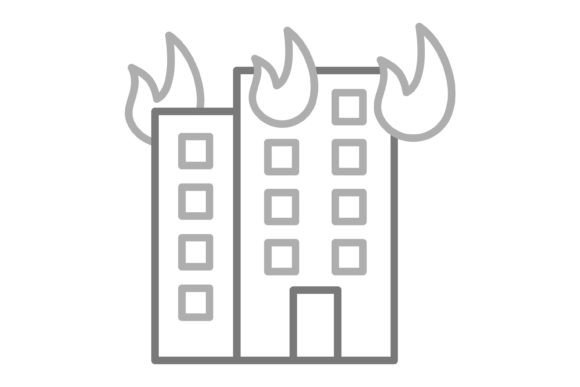
In the world of digital design and professional documentation, clarity and consistency are the bedrock of effective communication. When conveying complex information, such as safety protocols, emergency procedures, or architectural concepts, the specific visual language you choose impacts how quickly your audience understands the message. The Building Fire Greyscale Line Icon serves as a critical visual asset in this context. It is not merely a decorative element but a functional tool designed to standardize the representation of fire hazards, emergency exits, or building safety features across various media. For professionals ranging from safety officers to UI designers, having a reliable, scalable icon set is essential for maintaining a professional workflow.
The Strategic Value of Greyscale Line Art
Choosing a greyscale line icon over a colored or filled alternative is often a strategic decision rooted in design adaptability. While color can convey urgency, it can also clash with existing brand palettes or reduce legibility on certain backgrounds. The Building Fire Greyscale Line Icon offers a neutral baseline that integrates seamlessly into high-contrast documents, wireframes, and minimalist user interfaces. By stripping away color, the icon forces focus onto the shape and meaning, ensuring that the symbol for "fire" or "danger" remains recognizable regardless of the surrounding aesthetic. This makes it particularly valuable during the early stages of project planning, where the final color scheme may not yet be decided, or in environments where print costs are a concern and black-and-white reproduction is necessary.
Technical Specifications and File Format Utility
A major bottleneck in design workflows is often the incompatibility of file formats. An asset that works perfectly in a vector editing program may fail to render correctly on a website or in a mobile application. The Building Fire Greyscale Line Icon package addresses this by including five distinct formats: AI, EPS, JPG, PNG, and SVG. Understanding the specific use case for each file type is crucial for efficient implementation.
- AI and EPS Formats: These vector formats are the source files. They are essential for the design phase. If you are a graphic designer creating a new safety manual or a presentation template, these files allow you to edit stroke weights, resize the icon without loss of quality, and modify the design to fit specific layout requirements.
- SVG (Scalable Vector Graphics): For web developers and mobile app creators, the SVG format is the industry standard. It ensures that the Building Fire Greyscale Line Icon renders crisply on any screen resolution, from standard desktop monitors to high-density Retina displays. Because SVGs are code-based, they load faster and consume less bandwidth than image-based formats.
- PNG with Transparent Background: This format is the workhorse for general use. The transparent background allows the icon to be placed over photographs, textured backgrounds, or colored headers without a white box appearing around it. This is particularly useful for bloggers, marketers, and educators who need to quickly insert the icon into existing content without complex masking.
- JPG: While JPGs do not support transparency, they are universally compatible with nearly every software platform. They are ideal for quick previews, email attachments, or use in legacy systems where vector support might be limited.
Workflow Integration: Before, During, and After
The utility of the Building Fire Greyscale Line Icon extends across the lifecycle of a project. Integrating it effectively requires understanding where it fits into your specific process.
Pre-Production and Planning
Before a design is finalized, assets are often used as placeholders or wireframe elements. During the planning phase of a mobile app or a website, developers need to map out the user interface. Using a standardized icon set ensures that the navigation logic is sound. For instance, placing the fire icon in a "Safety" menu allows stakeholders to test the usability of the app before final assets are commissioned. This saves time and prevents the need for major structural changes later in the development cycle.
Production and Implementation
During the active creation of templates, presentations, or educational materials, consistency is key. If you are building a series of slides for a corporate safety training, using the same Building Fire Greyscale Line Icon throughout the deck creates a cohesive visual narrative. For freelancers managing multiple clients, having a library of scalable icons allows for rapid customization. You can easily adjust the SVG code to match a client's specific line-weight style or export the AI file to a specific print size for a poster without redrawing the artwork.
Post-Production and Quality Control
After a project is launched, maintenance becomes the priority. Websites and apps require updates, and print materials may need reprinting. The versatility of the included file formats simplifies this process. If a website redesigns its footer, the SVG can be re-coded to match the new CSS. If a safety manual needs to be reprinted on a different paper stock, the high-resolution vector ensures the icon remains sharp. This long-term usability prevents the "asset rot" that occurs when low-quality images become pixelated over time or when file formats become obsolete.
Practical Implementation Across Industries
The application of the Building Fire Greyscale Line Icon is not limited to one sector. Its neutral design makes it a multipurpose tool.
- For Educators and Trainers: Creating worksheets or digital learning modules often requires clear, distraction-free imagery. The greyscale line art is perfect for coloring activities for younger learners or for high-contrast handouts for adult education.
- For Architects and Engineers: Technical drawings require precise symbology. An editable vector icon can be integrated into CAD overlays or digital blueprints to denote fire suppression systems or evacuation routes without obscuring the underlying architectural details.
- For Content Creators and Bloggers: When writing about home safety, insurance, or emergency preparedness, a clean icon adds visual interest to the text. The transparent PNG format allows it to be floated within an article layout, breaking up large blocks of text and improving the reader's experience.
Optimizing for Performance and Usability
When implementing the Building Fire Greyscale Line Icon, performance optimization is a practical consideration. While the assets are high quality, they must be used correctly to ensure they do not negatively impact load times or user experience.
For web use, while the SVG is scalable, it is advisable to optimize the SVG code by removing unnecessary metadata. This ensures the file size is as small as possible. For mobile applications, developers should utilize the appropriate density buckets (mdpi, hdpi, xhdpi) if using raster versions, though the vector format remains the preferred method for modern Android and iOS development to ensure the icon scales perfectly across different device screen sizes.
Furthermore, usability extends to accessibility. When using the Building Fire Greyscale Line Icon on a website, it is vital to include proper alt text for screen readers. This ensures that visually impaired users understand that the icon represents a fire or safety concept. In presentation slides, the icon should be grouped with its descriptive text to ensure that when the slide is read aloud by assistive technology, the context of the icon is preserved.
Maintaining Visual Consistency
One of the most significant advantages of using a standardized icon pack is the ability to maintain visual consistency across a brand or project. When different team members—designers, developers, and content writers—are working on the same project, using the same source files for the Building Fire Greyscale Line Icon prevents the "Frankenstein" effect where different parts of a project use slightly different styles of the same symbol. By centralizing these assets in a shared drive or a design system repository, teams can ensure that every touchpoint, from a mobile notification to a printed safety sign, speaks the same visual language.
In summary, the Building Fire Greyscale Line Icon is more than just a graphic; it is a functional component of a robust design system. By leveraging the included AI, EPS, JPG, PNG, and SVG formats, professionals can ensure their projects are not only visually appealing but also technically sound, accessible, and easy to maintain over the long term.