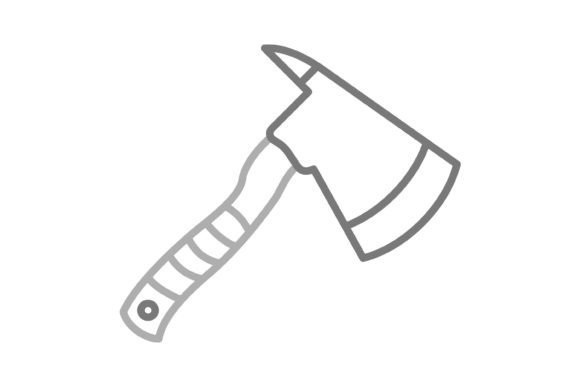
Understanding the Axe Greyscale Line Icon: A Practical Guide for Designers and Developers
When building a digital product, whether it's a mobile app, a website, or a marketing presentation, the small visual elements often carry the most weight. A single icon can define the tone of a user interface, guide a user's eye, or communicate a concept faster than a paragraph of text. The Axe Greyscale Line Icon is one such element, offering a clean, versatile visual metaphor for concepts ranging from "tools" and "craftsmanship" to "decisive action" or "cutting costs." However, simply finding an icon that looks good on a thumbnail is only the first step. Many projects stall or suffer quality issues because the integration phase was overlooked during the selection process.
It is a common scenario: a creator sees a sharp, minimalist axe icon, downloads it, and tries to implement it, only to find the colors are locked, the lines blur on mobile screens, or the file format doesn't play nice with their software. To avoid these frustrations, you need to understand not just what an icon looks like, but how it is built. The Axe Greyscale Line Icon typically comes in a package designed for versatility, but knowing how to leverage that versatility is key to a professional result.
The Importance of the "Greyscale" and "Line" Design
One of the first things to evaluate is the aesthetic choice. A greyscale line icon is not just a black-and-white drawing; it is a statement of intent. Unlike solid, colorful icons that can clash with your brand palette or look dated as design trends shift, a greyscale line icon offers neutrality and elegance. It serves as a foundational visual element that can be customized to fit any color scheme without looking muddy or out of place.
A frequent mistake here is assuming "greyscale" means "boring." In reality, line icons are the hallmark of modern, clean UI design. They reduce visual clutter and allow the content to breathe. However, a common misunderstanding is regarding the line weight. If the lines are too thin, the icon will disappear on high-resolution screens or become illegible when printed on textured paper. If they are too thick, it may look cartoonish. A well-designed Axe Greyscale Line Icon balances this, ensuring the "cutting edge" and the handle are distinct and readable even at small sizes.
Navigating File Formats: More Than Just Downloading
The true utility of a professional icon pack lies in the file formats included. You will often see packages offering AI, EPS, JPG, PNG, and SVG. Many users simply grab the JPG and move on, which is often a critical error that limits scalability and editing capabilities. To make an informed choice, you must understand the role of each format included in the zip file.
- SVG (Scalable Vector Graphics): This is arguably the most crucial format for modern web and app development. SVGs are code-based, meaning they are infinitely scalable without losing quality. If you use an SVG for the Axe Greyscale Line Icon on a responsive website, it will look crisp on a 4K monitor and a small smartphone alike. It also allows you to change the color using CSS, which is a massive efficiency booster.
- AI and EPS: These are the "source" files. Adobe Illustrator (AI) and Encapsulated PostScript (EPS) files are necessary if you need to modify the icon's shape, merge it with other graphics, or prepare it for high-end print. Ignoring these means you are stuck with the icon as-is.
- PNG (Transparent Background): While SVG is superior for web, PNG remains vital for situations where code-based graphics aren't supported, such as certain email marketing platforms or legacy presentation software. The "transparent background" feature is non-negotiable; an Axe icon with a white square box around it looks amateurish on any dark or colored background.
Avoiding the "One-Size-Fits-All" Trap
A significant error professionals make is applying the same icon file across every medium without optimization. The requirements for a mobile app icon are vastly different from those of a printed brochure or a PowerPoint presentation.
Mobile and Web Applications
For digital interfaces, performance is key. Loading heavy image files slows down your site. Here, the SVG format of the Axe Greyscale Line Icon is your best friend. However, a pitfall is failing to optimize the SVG code. Sometimes, vector files contain unnecessary metadata that bloats the file size. Before deploying, ensure the SVG is minified. Furthermore, consider the "touch target" on mobile. An icon that looks beautiful on desktop might be too small to tap comfortably on a phone screen. You need an icon that retains its legibility when scaled up for mobile navigation bars.
Print and High-Resolution Output
For print, such as business cards or flyers promoting a woodworking business, resolution is everything. A JPG or PNG will pixelate if you try to enlarge it. This is where the EPS or AI files become essential. These vector formats ensure that the Axe Greyscale Line Icon prints with razor-sharp edges, regardless of whether it's on a pen or a poster. A common oversight is color mode; digital screens use RGB, while print uses CMYK. While the icon is greyscale, converting the vector file properly ensures the black doesn't turn into a muddy dark grey during the print process.
Practical Advice for Integration and Editing
The description of a good icon pack often includes "Easy to edit and scale," but this promise is only fulfilled if you know what you are doing. Here is how to avoid common usability headaches:
- Check for Expandable Strokes: When you open the Axe Greyscale Line Icon in Illustrator, check if the lines are "live strokes" or "expanded." Live strokes allow you to change the thickness with a click. Expanded strokes are shapes themselves. If you need to match the icon's line weight to a specific font on your website, live strokes are significantly easier to work with.
- Color Customization: Since the icon is greyscale, you might assume changing the color is simple. It usually is, but be careful with opacity. Line icons often use transparency to create depth or intersections. If you change the color to a bright red, overlapping sections might look dark and muddy. Ensure the icon is designed with solid strokes if you plan to use bright, solid colors.
- Consistency in Sets: If you are using the Axe icon, you are likely using other icons. One of the biggest visual sins in design is mixing icon styles. If your Axe is a thin, greyscale line icon, do not pair it with a thick, colorful, cartoonish "trash can" icon. Look for sets that offer 100 or more icons to ensure you have a matching visual language for your entire project.
What to Check Before You Commit
Before you finalize your decision to use a specific Axe Greyscale Line Icon, perform a quick audit. This prevents the "download regret" that happens when you realize the asset doesn't fit your needs halfway through the project.
First, check the licensing. Even if an icon is free, it may require attribution or prohibit commercial use. If you are a freelancer building a site for a client, you must ensure the license covers the end product. Second, test the scalability. Zoom in on the preview. Do the lines remain consistent? Does the handle look balanced? Third, evaluate the metaphor. Does the axe look like a weapon, a woodcutting tool, or a generic symbol? Context matters. A stylized, abstract axe works well for a fintech app "cutting fees," while a realistic one suits a hardware store.
Ultimately, the Axe Greyscale Line Icon is a versatile tool in your design arsenal. By understanding the file formats, respecting the medium you are designing for, and verifying the technical details before you start, you ensure that this small visual element contributes to a professional, polished, and effective final product. It’s not just about having an icon; it’s about having the right icon, in the right format, used the right way.